
External commercial conflicts rarely resolve themselves. Whether the pressure comes from a supplier, a customer, a regulator, an insurer, or a contractual partner, the organisations that navigate conflict well follow a predictable pattern — not by accident, but by design.
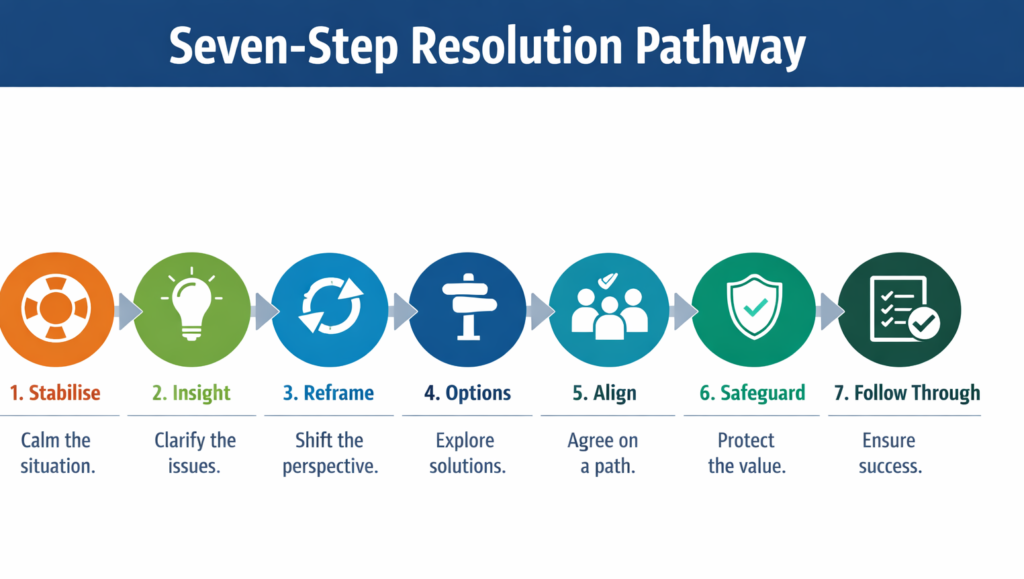
At RESOLVE, I use a structured seven‑step pathway to help businesses stabilise the situation, understand what’s really happening, and move toward a durable, commercially sensible outcome. This pathway works across industries and conflict types because it reflects how people make decisions under pressure and how organisations protect value when the stakes are high.
Here’s how the pathway works.
1. Stabilise — Calm the situation
Before anything else, the goal is to stop the escalation. This means reducing emotion, slowing the pace, and preventing further damage. In external disputes, stabilisation often involves clarifying communication channels, pausing reactive exchanges, and ensuring the organisation is not making the situation worse.
2. Insight — Clarify the issues
Most external conflicts are not about what they appear to be on the surface. Insight means understanding:
- what the other party actually wants
- what is driving their behaviour
- what risks are real versus perceived
- what constraints each party is operating under
This is where the real leverage is found.
3. Reframe — Shift the perspective
Reframing moves the conversation from positions (“We demand X”) to interests (“Here’s what we need to resolve this”). It helps both sides see the problem differently — often revealing solutions that weren’t visible before.
4. Options — Explore solutions
Once the problem is reframed, options emerge. This stage is about generating possibilities without committing too early. In external disputes, this often includes:
- commercial adjustments
- revised timelines
- alternative remedies
- structured commitments
- neutral evaluation
Options create movement.
5. Align — Agree on a path
Alignment is where the parties converge on a workable solution. This requires clarity, specificity, and a shared understanding of what success looks like. It’s also where misunderstandings are eliminated before they become future disputes.
6. Safeguard — Protect the value
A good resolution is only as strong as the protections around it. Safeguarding includes:
- documenting agreements clearly
- setting review points
- ensuring compliance
- managing reputational and regulatory risk
This step prevents the conflict from re‑emerging.
7. Follow Through — Ensure success
Most disputes fail after agreement because no one monitors implementation. Follow‑through ensures commitments are met, relationships stabilise, and the organisation returns to normal operations.
Final Thought
External conflicts are inevitable. Escalation is not.
A structured pathway gives leaders clarity, confidence, and control — even when the pressure is coming from outside the organisation. If you’re facing a dispute with a supplier, customer, regulator, or partner, this seven‑step approach can help you move from uncertainty to resolution.
External conflicts don’t resolve themselves. Suppliers, customers, regulators, insurers — when something goes wrong, the pressure comes fast.
What most leaders don’t have is a clear pathway for navigating that pressure.
I’ve just published a new piece on the Seven‑Step Resolution Pathway — the model I use to help NZ organisations stabilise external disputes and move toward commercially sensible outcomes.
If you deal with external partners, this framework will help you see conflict differently — and resolve it faster.
Leave a Reply